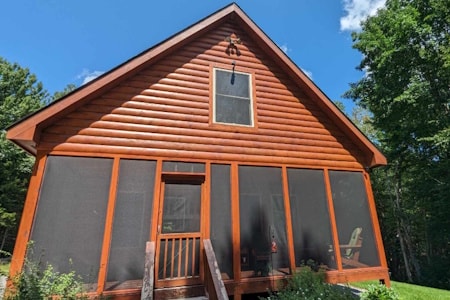
Every Adirondack log home tells a story with its exterior. The grey weathered wood, the black streaks running down between the logs, the stain that has started peeling away from the surface. These are not signs of a home that is aging gracefully. They are distress signals. And the longer they go unanswered, the more the story ends in rot, structural damage, and a restoration bill that is a lot heavier than it needed to be.
Why Log Home Exteriors Fail
Log home exteriors in Upstate New York face a level of punishment that most homeowners significantly underestimate. It is not just rain and snow. It is the specific combination of Adirondack weather patterns, seasonal extremes, and the natural biology of wood that makes exterior log maintenance a real and recurring need rather than a once-and-done project.
The Adirondack Climate is Relentless
Upstate New York winters are not gentle. Temperatures drop hard, stay low for months, and then swing back. That freeze-thaw cycling is one of the most destructive forces a log home exterior faces. Water finds any small opening, freezes, expands, and physically forces that opening wider. By spring, gaps that were hairlines in October are now visible cracks. Water that enters those gaps in spring snowmelt now has an easy path into the wall cavity.
Summers bring their own assault. UV radiation from the sun is the primary force that destroys exterior log finishes. The sun does not just fade the color. It breaks down the lignin that gives wood its structural integrity at the surface. Over two to three seasons of unprotected UV exposure, a log surface that should be golden and tight-grained becomes grey and fibrous, almost spongy at the surface, and completely unable to repel water effectively.
The Natural Biology of Wood Does Not Help
Wood is an organic material that was designed to cycle through moisture. Left without proper protection, it will absorb water in wet conditions and release it as conditions dry. Every one of those cycles expands and contracts the log, working joints open over time. It also creates the conditions that mold, algae, and wood-destroying fungi need to establish themselves. A log that has been allowed to stay wet for extended periods is not just discolored. It has been actively colonized by organisms that continue breaking down the wood structure as long as moisture and organic material are available.
"Grey wood is not a cosmetic problem. It means the lignin at the surface is actively decomposing. The clock is already running."
Hogwash Cleaning Solutions, Queensbury NY
The Myths That Cost Cabin Owners Thousands
There is a lot of bad advice floating around about log home maintenance. These are the myths we see causing the most damage to Upstate New York cabins.
Reality
High-pressure washing drives water behind the wood surface and into checks, forces biological growth deeper into the grain instead of eliminating it, and physically damages log fibers. It also does not remove failing stain. Soft washing with the right chemistry followed by proper mechanical prep is the correct sequence.
Reality
Staining over a failing finish traps moisture between the layers, prevents proper adhesion, and causes the new coat to fail within one to two seasons. A full strip back to bare wood is required for the new finish to bond correctly and last as long as it should.
Reality
Every log home settles. Every one. Logs shrink as they dry. Freeze-thaw cycling works joints open over time. A home that was genuinely tight on day one almost certainly needs full exterior chinking within 5 to 10 years. The joints are open. They are letting in water. The "chink-free" designation was a day-one reality, not a lifetime guarantee.
Reality
Grey wood means the surface lignin has been degraded by UV exposure. The wood is absorbing water freely, expanding and contracting with every weather cycle, and providing ideal conditions for mold and fungi to establish. It is not protecting itself. It is in the early stages of structural breakdown at the surface.
When to Do Exterior Work in Upstate New York
| Season |
Conditions |
What Works |
What to Avoid |
| Early Spring (Apr–May) |
Cool, variable, wood drying from winter saturation |
Assessment, soft washing, chinking repairs, stripping |
Stain application until moisture levels drop below 19% |
| Late Spring (May–Jun) |
Warming temps, lower humidity, good drying conditions |
Full restoration projects, stain application, media blasting |
Working in direct rain or within 24 hours of rainfall |
| Summer (Jun–Aug) |
Warm, often humid, peak UV exposure |
Staining early morning or evening, chinking in shade |
Applying stain in direct afternoon sun or temperatures above 90°F |
| Early Fall (Sep–Oct) |
Excellent for log work. Cooler temps, lower humidity, good curing conditions |
Full restoration projects. Ideal staining window for Upstate NY |
Waiting past mid-October in the Adirondacks |
| Late Fall / Winter |
Freezing temperatures, snow and ice, wet wood |
Planning, assessment from inside, scheduling spring work |
Any exterior stain, chinking, or caulk application |
The Window Is Shorter Than You Think
In the Adirondack region, the practical exterior restoration season runs roughly mid-May through mid-October. That is five months, and many of those days involve rain, extreme heat, or humidity conditions that make stain application inadvisable. Book early. The best contractors fill their schedules fast and the late-season rush is real.
How to Make the Results Last
A full exterior restoration is a significant investment. These habits protect it.
- Do the water bead test every spring. Spray water on the log surface. It should bead and roll off within seconds. If it absorbs into the wood instead, the hydrophobic properties of the finish are depleted and recoating time is approaching. Do not wait for visible finish failure before acting.
- Walk the chinking lines every spring after the freeze-thaw season. Look for any cracks, separations, or voids. A small repair done in May costs a fraction of the interior restoration that same gap will require by October if left alone through a summer of rain.
- Keep gutters clean and draining away from the log wall. Overflowing gutters are one of the most overlooked sources of log saturation. Lower log courses that stay perpetually wet are the first to show rot and the first to stain interior surfaces.
- Trim vegetation back from the log walls. Shrubs, vines, and branches that contact the log surface hold moisture against the wood and prevent it from drying between weather events. They also provide a direct highway for insects into the logs.
- Check downspouts and grading at the foundation. Ground that slopes toward the home allows water to pool against lower log courses. The fix is often simple regrading but the damage from years of wet lower logs is not.
- Plan for recoating every 3 to 5 years on high-exposure walls. South and west walls in Upstate New York take more UV punishment than other exposures. Maintenance coats applied before visible failure cost significantly less than full stripping and restoration projects driven by finish that has already peeled.